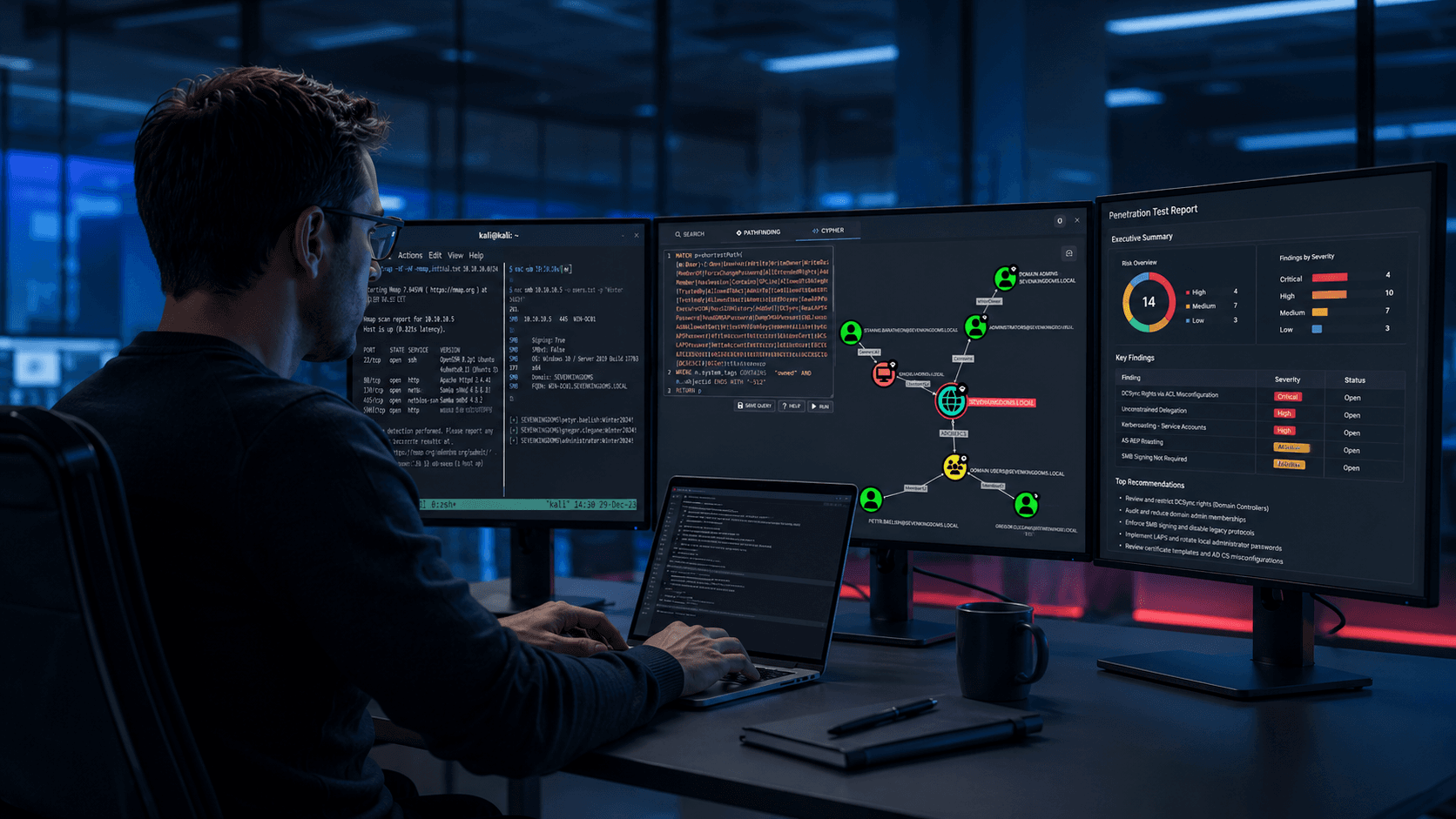
A penetration test is a controlled break-in into your own systems. You pay someone to behave like an attacker, except they write down exactly how they got in afterward.
The point is simple: You want to find the gaps before someone who means business does.
That is the short answer. Here is the rest.
The difference from vulnerability scanning
This gets confused all the time, so let's clear it up first:
A vulnerability scan is automated. A tool probes your system and lists known issues: outdated software, open ports, missing updates. Fast, cheap, superficial.
A penetration test is manual work. A human actually exploits the findings, chains them together, and sees how far they can get. They find what no scanner sees: business logic flaws, broken permissions, creative attack paths.
Picture it this way: A scan tells you a window is open. A pentest climbs through, walks through the house, and shows you they can get from there to the safe.
Types of penetration tests
"Pentest" is an umbrella term. Depending on what is being tested, the engagement looks completely different:
- Web application: login flows, forms, APIs, payment processes. The classic for anyone offering something online.
- External network: everything reachable from the outside. Your attack surface on the internet.
- Internal infrastructure: the attacker is already on the network. How far do they get? Active Directory often plays a big role here.
- Red teaming: the most realistic variant. Unannounced, using every available method, to test whether your detection even triggers.
- Social & physical: humans as the entry point. Phishing, a phone call, someone sneaking into the building.
- Microsoft / cloud: misconfigurations in Entra ID, M365, and Azure. That is where most companies have serious gaps.
Which type you need depends on where your risk sits. Most teams start where the most damage could happen.
How a pentest runs
A solid test always follows the same phases:
- Scoping: What gets tested, what does not, and from which perspective. This is where the boundaries are set.
- Reconnaissance: Gathering information. What is there, and what is reachable?
- Exploitation: Finding and exploiting vulnerabilities. The core of the work.
- Post-exploitation: How deep can you go? From a small gap to full access.
- Reporting: What was found, how critical it is, and how to fix it.
- Retest: After remediation, checking again whether the fixes actually hold.
Testing follows recognized standards: OWASP, PTES, OSSTMM, or the guidelines from BSI. That helps ensure nothing important is missed.
The report is the actual product
A pentest is only as good as its report. And a good report has two layers.
For technical teams: Where exactly is the gap, how was it exploited, and how do you fix it concretely.
For management: What does this mean for the business, how critical is it, and what does doing nothing cost. A CEO should understand where they stand on one page, without ever seeing a command line.
Who needs a penetration test?
Short answer: more companies than think they do. It becomes concrete when you:
- Process customer data and do not want to lose trust
- Need to prove compliance: ISO 27001, NIS2, DORA, TISAX
- Have or want cyber insurance (insurers increasingly require this)
- Are launching a new application before real users are on it
- Have already had an incident and want to know whether anything is still open
And honestly: If you make money online, the question is not whether someone will attack, but when. A pentest shifts the answer to "and nothing happened."
The next step
If you want to know what a test means for you specifically, in scope and price, a short conversation is worth it. We look at your risk and tell you honestly where a test delivers the most value. Even when that answer is "not yet."
Request a free initial consultation →
daqoon: We break in before others do.